Cultural Significance of Head Care in Japanese Culture
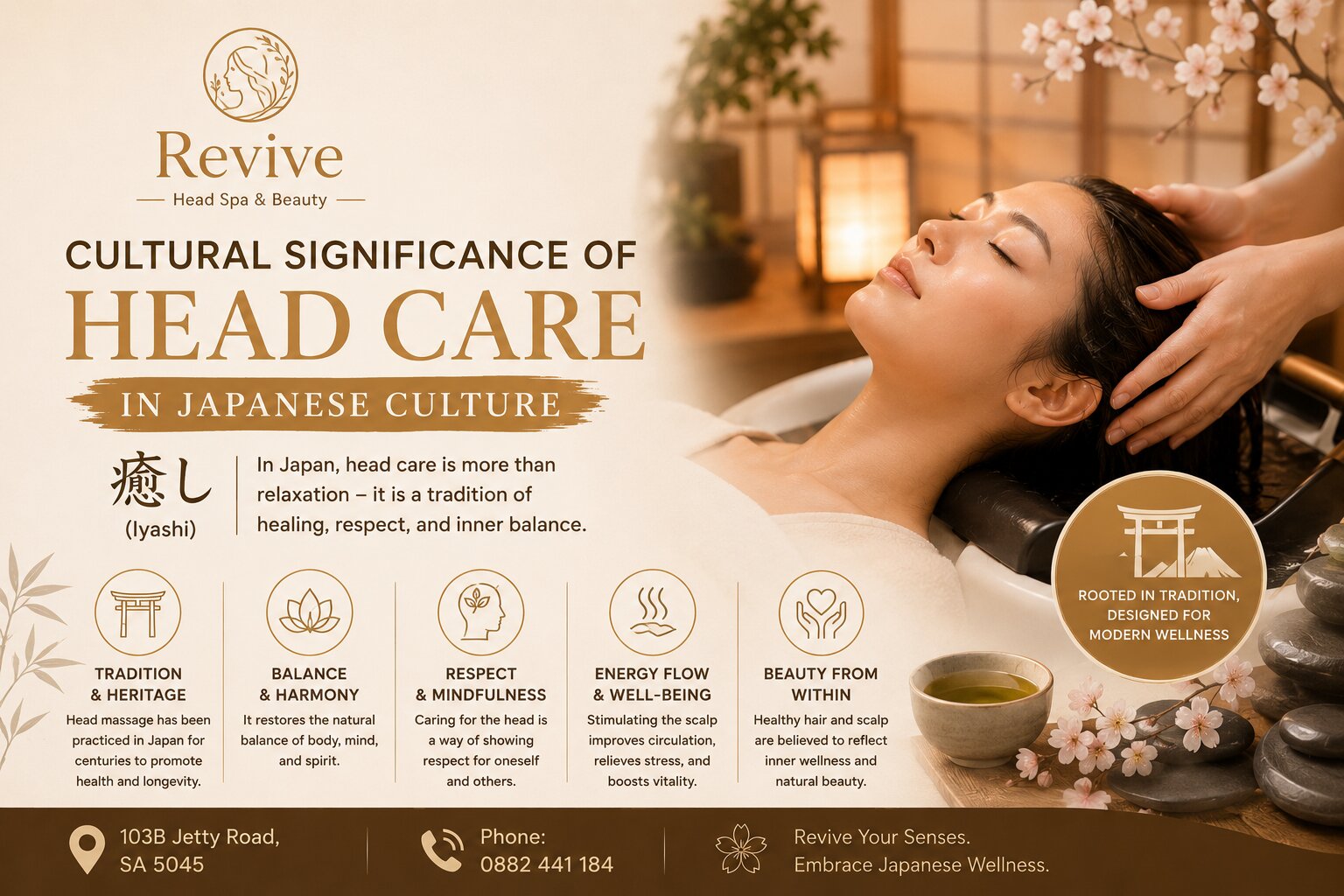
In Japan, the act of caring for one's head is far more than a beauty routine — it is a deeply spiritual, social, and philosophical practice woven into thousands of years of culture. From the sacred Shinto rituals of ancient Japan to the ultra-refined head spa experiences now gaining a devoted following in cities like Sydney, the Japanese approach to head care offers a timeless blueprint for holistic wellbeing.
Whether you have visited a Japanese head spa, received a tsuboki scalp massage, or simply found yourself drawn to the unhurried precision of Japanese grooming traditions, understanding the cultural roots of these practices adds an entirely new dimension of appreciation. This article explores where these traditions come from, why they endure, and how they continue to influence modern wellness culture — here in Australia and around the world.
The Sacred Status of the Head in Japanese Tradition
In Japan, the head has historically been regarded as the most sacred part of the human body. This belief is grounded in Shinto — Japan's indigenous spiritual tradition — which holds that kami (divine spirits or energies) reside in all things, including the human body. The head, as the highest point of the body, is considered closest to the heavens and therefore the most spiritually significant.
This reverence manifests in numerous social customs that persist to this day. Bowing — the cornerstone of Japanese social etiquette — is not merely a gesture of politeness; it is a deliberate act of lowering one's head to show respect, humility, and deference. The deeper the bow, the greater the respect conveyed. Conversely, touching another person's head uninvited is considered a serious breach of social propriety across all age groups.
Did you know? In traditional Japanese households, it was customary for family members to care for each other's hair and scalp as an act of deep affection and trust. This intimate grooming ritual — known informally as keshō no sewa — strengthened familial bonds in ways that transcended mere hygiene.
Advertisement · Scroll to continue
A Historical Journey Through Japanese Head Care Practices
Japanese head care traditions have evolved over many centuries, shaped by Buddhism, Chinese medicine, indigenous Shinto practices, and later by contact with the wider world. Here is a brief historical overview of how these customs developed:
During the Heian period, hair length and style were key indicators of social rank and virtue — particularly for women. Court ladies of the imperial palace grew their hair to extraordinary lengths, sometimes trailing several metres behind them. Grooming rituals were elaborate and could occupy hours each day, performed with precision by dedicated attendants using camellia oil and wooden combs.
Samurai warriors developed their own distinct grooming code. The iconic chonmage — a topknot hairstyle formed by shaving the top of the head — was not merely practical (it allowed helmets to fit properly) but carried deep cultural meaning. A samurai's topknot was a symbol of honour; its removal in defeat or death was a profound ritual act. Scalp health was maintained carefully, as the health of the head was seen as a reflection of inner strength.
The Edo period saw head care become a formalised profession. Kamisuki — hair dressers who specialised in elaborate hairstyles — became central figures in daily life. Visits to the kamisuki were social events as much as grooming appointments. The geisha of this era elevated hair art to extraordinary levels of refinement, with the maintenance of their iconic hairstyles requiring regular, intensive scalp care, oiling, and massage.
With Japan's rapid modernisation following the Meiji Restoration, Western influence began to reshape grooming customs. The chonmage was officially banned in 1871. However, deeply embedded practices — particularly the use of natural oils, scalp massage, and holistic self-care — endured in households and traditional establishments, quietly preserved as a form of cultural continuity.
The contemporary Japanese head spa emerged in the late twentieth century as a sophisticated fusion of traditional scalp care philosophy with modern dermatological science. Japanese head spa salons now offer multi-step treatments including scalp analysis, deep-cleanse washes, oil infusions, and pressure-point massage — all executed with the quiet precision that is a hallmark of Japanese craft culture.
The Philosophy Behind Japanese Scalp Care
To understand Japanese head care is to understand a broader cultural philosophy: the idea that the outer self reflects the inner self. In Japanese aesthetic philosophy — deeply influenced by concepts such as wabi-sabi (finding beauty in imperfection), mono no aware (the bittersweet awareness of impermanence), and ma (the art of meaningful pause) — care for the physical body is inseparable from the cultivation of one's spirit and character.
This philosophy means that Japanese scalp care has never been purely cosmetic. Looking after the health of your scalp and hair is considered:
Advertisement · Scroll to continue
-
🧘A Form of Mindfulness The slow, deliberate nature of head massage — often performed in near-silence — is considered a meditative act, training the mind to be present and the body to release accumulated tension.
-
🌸An Expression of Self-Respect Caring for one's hair and scalp is viewed as an act of respect towards oneself and, by extension, towards others in one's social sphere. Appearing well-groomed in Japan signals discipline and consideration.
-
⚡A Health Practice, Not Just Beauty Traditional Japanese medicine holds that the scalp contains numerous vital acupressure points connected to organ systems throughout the body. Scalp massage is therefore considered a form of preventive healthcare, promoting circulation, lymphatic flow, and nervous system balance.
-
🤝A Social and Familial Bond Historically, grooming one another's hair was a deeply intimate act shared between close family members and trusted companions. This communal dimension of head care speaks to Japan's collectivist culture, where physical wellbeing is never entirely private.
"In Japanese wellness culture, caring for the scalp is not a luxury — it is the foundation upon which health, clarity, and beauty are built."— Revive Head Spa Beauty
Tsuboki: The Ancient Art of Scalp Pressure-Point Massage
One of the most distinctive elements of traditional Japanese head care is the practice of tsuboki — a specialised massage technique that applies pressure to specific points on the scalp, face, neck, and shoulders. The word tsubo (壺) refers to a pot or vessel, but in the context of traditional Asian medicine, it denotes the acupressure points that serve as gateways to the body's energy pathways, or meridians.
Tsuboki draws on the ancient Chinese medical system of qi (life energy) and its Japanese equivalent, ki, which holds that blockages or imbalances in the body's energy pathways manifest as physical discomfort, illness, or emotional distress. By applying measured pressure to specific scalp points — such as those at the crown (hyakue), the temples (taiyo), and the base of the skull (fubai) — a skilled tsuboki practitioner aims to:
- ✦ Relieve chronic tension headaches and neck stiffness
- ✦ Improve blood circulation to the scalp and hair follicles
- ✦ Stimulate lymphatic drainage and reduce facial puffiness
- ✦ Support the nervous system and reduce cortisol (stress hormone) levels
- ✦ Encourage hair follicle activity and promote healthy hair growth
Unlike many Western massage traditions, tsuboki does not rely on forceful manipulation. Its power lies in its specificity — the precise location of each pressure point, the duration and angle of pressure applied, and the sequence in which points are addressed. This requires years of training and a thorough understanding of the body's energetic map.
Sacred Ingredients: What Traditional Japanese Head Care Uses
Japanese head care is inseparable from the natural ingredients that have been refined and celebrated over centuries. Here are the most iconic botanicals in the traditional Japanese hair and scalp care toolkit:
The gold standard of Japanese hair oils for over 1,000 years. Rich in oleic acid and antioxidants, tsubaki oil penetrates the hair shaft and scalp without leaving residue, delivering deep moisture and extraordinary shine. Geisha used it to maintain their elaborate hairstyles.
A powerful antioxidant and anti-inflammatory agent. Applied to the scalp, catechins in green tea may help to reduce dandruff, soothe irritation, and protect follicles from oxidative stress — a core principle of Japanese preventive health culture.
Used for centuries by women in Japan and throughout Asia, fermented rice water is rich in inositol and amino acids that strengthen the hair shaft, reduce breakage, and impart smoothness. Its use dates to the Heian court ladies famed for their lustrous floor-length hair.
This fragrant Japanese citrus is packed with Vitamin C and bioflavonoids. In scalp care, yuzu extract supports collagen synthesis in the scalp's dermal layer, brightens the complexion, and provides a naturally uplifting aromatherapy effect during treatments.
Sacred to Shinto practice, hinoki cypress has antimicrobial and calming properties. Its distinctive warm, woody aroma is deeply grounding and is frequently incorporated into premium head spa rituals to create a sense of sacred space and mental calm.
Japan's coastal diet and beauty philosophy embrace marine ingredients wholeheartedly. Seaweed-based scalp treatments provide minerals including iodine, iron, and zinc — all critical for hair follicle health and associated with Japan's remarkably low rates of alopecia.
Geisha Culture and the Art of the Hair Ritual
Perhaps no group embodies the cultural depth of Japanese head care more completely than the geisha. These accomplished artists — trained in music, dance, conversation, and traditional arts — wore some of the most complex hairstyles in human history, many of which required not sleeping flat in order to preserve their shape.
The preparation of a geisha's hair was a sacred ritual in itself. A dedicated katsura-shi (wig maker or hair stylist) would attend to each geisha, spending hours applying traditional styling waxes made from bintsuke abura (a blend of camellia and sesame oils) and constructing intricate arrangements supported by lacquered pins and silk cords.
Advertisement · Scroll to continue
Because traditional geisha hairstyles placed considerable tension on the scalp — and because the women slept on raised wooden pillows (takamakura) to preserve their hair overnight — scalp massage and oiling were not optional luxuries. They were essential health maintenance, keeping the scalp from becoming dry, irritated, or inflamed under constant stress. This gave rise to deeply ritualised scalp care protocols that are the direct ancestors of modern Japanese head spa treatments.
The Maiko's Head Care Secret: Young geisha apprentices (maiko) in Kyoto still wear their natural hair elaborately styled, and many undergo weekly tsuboki massage sessions and tsubaki oil treatments to counteract the physical demands of their hairstyles. This living tradition directly connects contemporary head spa practice to centuries of cultural refinement.
The Japanese Head Spa in the Modern World
The modern Japanese head spa — heddo spa (ヘッドスパ) — emerged in the 1990s and 2000s as a standalone wellness category distinct from conventional hair salons. Where a standard salon visit focuses on cut, colour, and style, the head spa experience is entirely dedicated to the health of the scalp and the restoration of mind-body balance.
What a Japanese-Inspired Head Spa Treatment Typically Includes
Authentic Japanese head spa experiences follow a multi-step protocol that draws directly on traditional practices:
-
🔬Scalp Analysis A microscopic examination of the scalp to assess oil production, follicle health, hydration levels, and any signs of irritation or sensitivity — the foundation of a personalised treatment plan.
-
💧Deep-Cleanse Ritual A multi-step cleansing process using enzyme-based or clay cleansers to remove build-up, excess sebum, and environmental pollutants from the scalp, creating a clean foundation for subsequent treatments.
-
🫙Oil Infusion Treatment Warm botanical oils — often centred on tsubaki — are massaged into the scalp to nourish follicles, restore the scalp's lipid barrier, and induce the deeply relaxed state known in Japanese as yuragi (gentle rocking or oscillation).
-
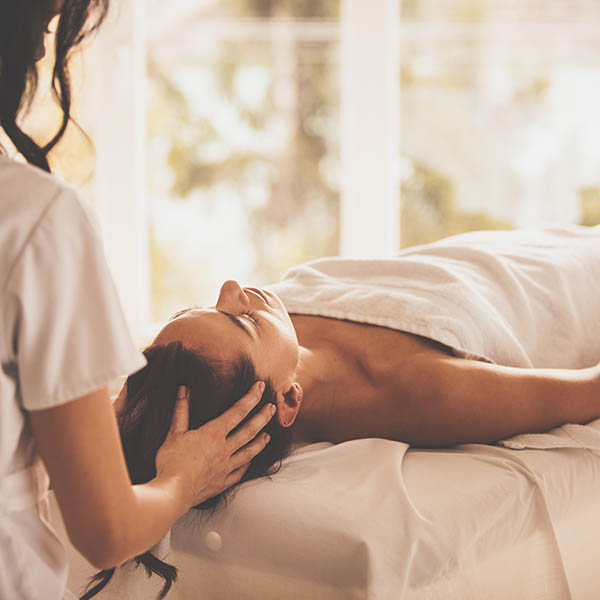
🤲Tsuboki Pressure-Point Massage The centrepiece of the Japanese head spa experience — a systematic journey through the scalp's acupressure points, releasing tension, supporting circulation, and inducing a state of profound calm.
-
✨Finishing & Scalp Conditioning The treatment concludes with the application of targeted serums or conditioners to seal in moisture, balance the scalp's pH, and protect the hair shaft — leaving the hair visibly glossier and the mind noticeably clearer.
🌸 Explore Asian Head Spa Traditions in Sydney
Why Japanese Head Care Resonates So Deeply in Australia
Australia — and Sydney in particular — has embraced Japanese wellness culture with remarkable enthusiasm. The reasons are multi-layered. There is, of course, the practical appeal: Japanese head spa treatments deliver measurable results for scalp health, hair quality, and stress relief. But there is something deeper at work as well.
In a cultural moment defined by burnout, digital overstimulation, and the erosion of meaningful ritual, the Japanese head spa offers something genuinely rare: a space of unhurried care, where the act of attending to one's head becomes a form of mindful presence. The treatment is not rushed, not commodified, not optimised into a 30-minute slot. It is an hour or more of deliberate, skilled attention — precisely the antidote many Australians are seeking.
Sydney's multicultural makeup also plays a role. With a large and vibrant Japanese-Australian community and a broad culture of culinary and wellness curiosity, Sydneysiders are well-placed to appreciate the nuance and depth of Japanese head care traditions. Many clients who come for the scalp benefits stay for the cultural experience — and leave with a new understanding of what it means to truly slow down.
The Intersection of Shinto and Scalp Health
To round out our understanding of Japanese head care, it is worth returning to its spiritual roots. In Shinto practice, purification — misogi harae — is a central concept. The body must be kept clean and ritually pure as a form of respect for the kami and for the community. Hair, as one of the most visible expressions of the self, is central to this purification practice.
Many traditional Shinto shrines across Japan feature hairaijin — deities associated with hair and its protection. Artisans who worked with hair — including kamisuki and wig-makers — would pray at these shrines for the health of their craft and their clients. Even today, hair salons in Japan occasionally maintain small Shinto altars as a form of occupational reverence.
This spiritual framing transforms the act of scalp care into something with genuine existential weight: it is not vanity, but virtue. Not indulgence, but devotion — to oneself, to one's community, and to the living world.
Frequently Asked Questions
In Japanese culture, the head is considered the most sacred part of the body, rooted in Shinto spiritual beliefs about purity and the proximity of the head to the divine. Caring for one's head and hair is an act of self-respect, social consideration, and spiritual maintenance. This reverence is expressed through elaborate grooming customs that have been refined across thousands of years of cultural history.
Tsuboki is a traditional Japanese massage technique that applies deliberate pressure to specific acupressure points on the scalp, face, neck, and shoulders. Drawing on ancient Chinese medicine and Japanese ki philosophy, tsuboki aims to release energy blockages, improve circulation, relieve tension headaches, and promote overall wellbeing. It is a central component of authentic Japanese head spa treatments.
Advertisement · Scroll to continue
Western hair care is primarily cosmetic, focusing on the appearance of the hair strand through colouring, cutting, and styling. Japanese head care begins at the scalp — treating it as the living foundation from which healthy hair grows — and integrates spiritual, psychological, and physical wellbeing into a holistic ritual. The Japanese approach is preventive and holistic where the Western approach tends to be remedial and aesthetic.
Tsubaki (camellia) oil is the most celebrated and historically significant traditional Japanese hair oil, used for over a millennium to nourish the scalp and add extraordinary shine to the hair. Other key ingredients include rice water, green tea extract, yuzu, hinoki cedar, and seaweed — all prized for their ability to support scalp health and hair vitality through natural means.
Absolutely. Sydney has developed a thriving head spa culture, with several premium salons offering Japanese-inspired treatments including scalp analysis, tsuboki pressure-point massage, camellia oil infusions, and deep-cleanse rituals. Revive Head Spa Beauty offers authentic Asian-inspired head spa experiences drawing on Japanese and broader East Asian wellness traditions.
Head Care as a Way of Life
The cultural significance of head care in Japan is not a relic of the past — it is a living tradition, continuously renewed by the practitioners, salons, and individuals who understand that true wellness begins at the crown. In Japan, to care for your head is to care for your whole self: body, mind, and spirit in seamless unity.
As this tradition finds new expressions in cities like Sydney, it carries with it something invaluable: a philosophy of slowness, precision, and reverence in an age that desperately needs all three. Whether you are drawn to the science of scalp health, the meditative rhythm of tsuboki massage, or the rich cultural story behind every drop of camellia oil, the Japanese approach to head care has something profound to offer — and it is more accessible than ever before.