
How Often Should You Wash an Oily Scalp? The Honest Answer
If you have an oily scalp, washing your hair every single day probably feels non-negotiable. Go a day without it and you're greeted with flat, greasy roots by mid-morning. Skip two days and it starts to feel borderline unwashable. So you wash again, and the cycle repeats — each wash feeling more urgent than the last. It's exhausting, and it's also, almost certainly, making your oily scalp worse.
The relationship between washing frequency and scalp oiliness is one of the most misunderstood aspects of hair care. More washing does not equal less oil — and for many people, the opposite is true. Your scalp has a finely tuned self-regulating system, and how often you wash directly shapes how aggressively that system operates. Understanding this dynamic is the single most effective thing you can do to reduce scalp oiliness over the long term, often without changing your shampoo at all.
This guide explains the real relationship between washing frequency and oil production, how different hair types should approach the question, and — most importantly — how to break the daily-washing cycle without suffering through weeks of miserable, unwashed-looking hair. For a full picture of what's driving your oily scalp beyond just washing habits, see our guide on why your scalp is so oily.
Can You Wash Too Often?
Yes — and most people with oily scalps are doing exactly that. The logic feels intuitive: oily scalp produces excess sebum, washing removes sebum, therefore washing more often should keep oiliness under control. The problem is that this logic ignores what happens at the sebaceous gland level in response to repeated cleansing.
Advertisement · Scroll to continue
When you shampoo, you remove oil from the scalp surface. If you shampoo with a conventional sulphate-based formula, you remove it very efficiently — often more completely than your scalp's homeostatic system expects. The sebaceous glands detect this sudden depletion and respond by ramping up sebum production to restore the scalp's protective oil layer. The more frequently and aggressively you wash, the more consistently the glands are triggered to produce at elevated rates. Over months and years of daily washing, this elevated production can effectively become your scalp's new baseline — meaning it now needs to produce more oil just to maintain what it considers "normal."
This phenomenon is sometimes called sebaceous rebound or the oil rebound cycle, and it's the primary reason why people who wash daily tend to have oilier scalps than those who wash every two to three days. The scalp has literally been trained to overproduce. The good news is that this training can be reversed — but it requires patience and a willingness to tolerate some discomfort during the transition period. Switching to a gentler, balancing shampoo formula at the same time as reducing frequency significantly speeds up the recalibration process.
The overwashing feedback loop: Frequent washing → aggressive oil removal → sebaceous glands detect depletion → increase production to compensate → scalp oilier than before → wash more often → repeat. Breaking this cycle requires reducing frequency even when it initially feels counterintuitive.
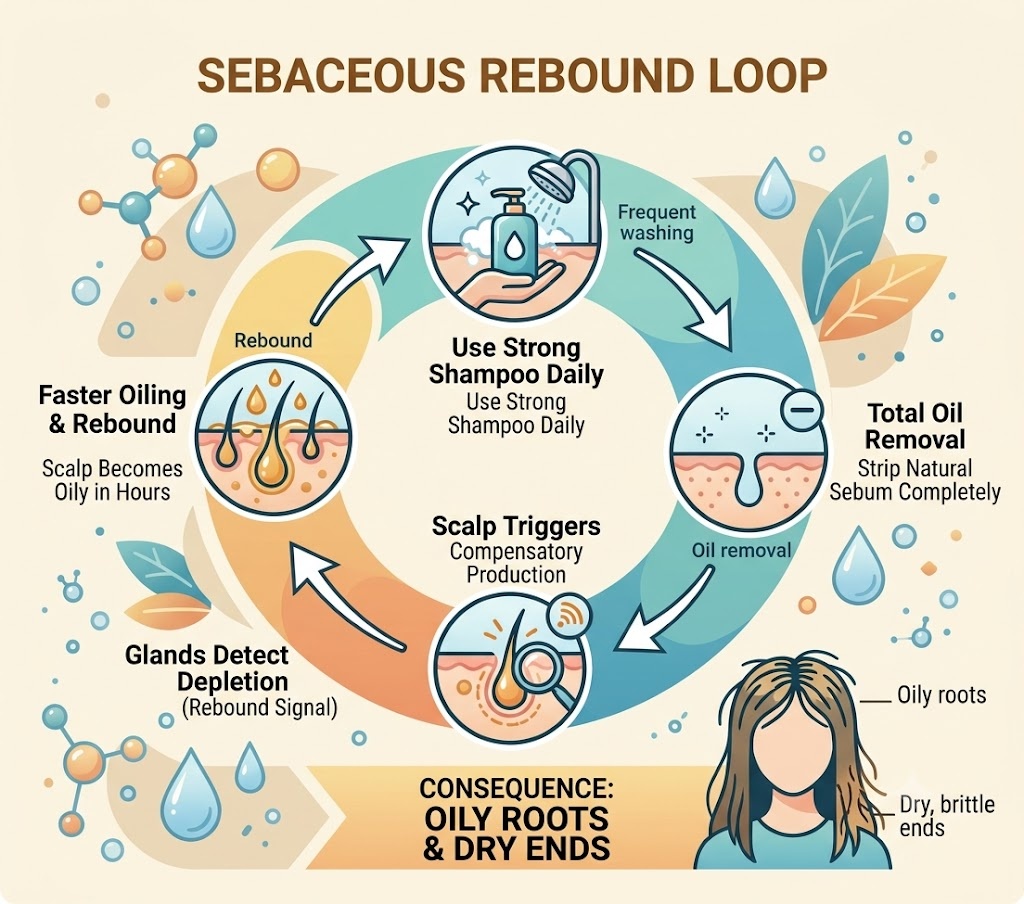
It's also worth noting that overwashing doesn't just affect the scalp — it strips the hair shaft of the moisture and protein it needs to stay strong and flexible. The result for many people is a frustrating combination of greasy roots and dry, brittle ends: an oily scalp but dry hair, where the two problems reinforce each other. If this sounds familiar, reducing washing frequency and switching to a gentler formula will address both issues simultaneously rather than requiring separate treatments for each.
Daily vs Every Other Day
The practical question most people want answered is simple: should I wash daily, or every other day? For the overwhelming majority of people with an oily scalp, every other day — or even every two to three days — is the more effective frequency. But the comparison is more nuanced than a simple rule.
| Factor | Daily Washing | Every Other Day (or Less) |
|---|---|---|
| Effect on sebum production | Encourages rebound overproduction over time | Allows sebaceous glands to self-regulate and downregulate |
| Scalp barrier health | Gradually compromises the acid mantle and barrier function | Supports a healthy, intact scalp barrier |
| Hair shaft condition | Strips moisture and protein repeatedly; increases breakage risk | Allows natural oil distribution along the shaft; improves condition |
| Short-term greasiness | Controlled day-to-day but never truly improving | May feel worse for 2–4 weeks during transition before improving |
| Long-term oiliness | Stays the same or worsens as baseline production rises | Typically improves significantly within 4–8 weeks |
| Scalp microbiome | Disrupted repeatedly; less diverse and resilient | More stable; supports a balanced microbial environment |
There are legitimate situations where daily washing makes sense in the short term — during periods of heavy sweating from exercise or manual work, immediately after scalp treatments that need to be rinsed, or when scalp conditions require it during an acute flare. In these cases, using a very gentle, sulphate-free formula and following with a lightweight conditioner on the lengths only minimises the rebound risk. But as an ongoing habit for managing oiliness, daily washing is working against you.
The transition from daily to every-other-day washing is the hardest part for most people. During the first two to four weeks, your scalp will likely produce noticeably more oil than usual because it's still operating at its elevated baseline. This is temporary — not a sign that your scalp "needs" daily washing. Staying the course through this period, using a light dry shampoo sparingly on off-wash days, and reminding yourself that improvement takes several weeks is what gets most people through it successfully.
Advertisement · Scroll to continue
How to transition from daily to every-other-day washing:
- Week 1–2: Wash every other day using a gentle, sulphate-free formula. On off days, use a light dry shampoo at roots only if needed.
- Week 3–4: Maintain the every-other-day schedule even when it's uncomfortable. Resist the urge to wash early — the discomfort is temporary and is a sign the recalibration is working.
- Week 5–6: Try extending to every two days. Many people find the greasy feeling arrives noticeably later than it did at the start.
- Week 7–8: Assess your new baseline. Most people can comfortably maintain every two to three days by this point with meaningfully less oil than when they started.
Washing Frequency by Hair Type
There is no single correct washing frequency for oily scalps because hair type, texture, and density all influence how quickly sebum becomes visible and how long you can comfortably go between washes. The following guidance gives a realistic starting point for each hair type — adjust based on how your scalp responds over the first few weeks.
Fine, Straight Hair
Fine hair has the least surface area to absorb and distribute sebum, which means oil reaches the visible surface of the hair shaft faster than with thicker textures. People with fine, straight hair often feel oily within 24 hours of washing and are the most likely to fall into the daily-washing trap. Start with every other day rather than jumping to longer intervals — this is usually the most your scalp can manage comfortably early in the transition. With consistency, most people with fine hair can comfortably reach a wash every two days within six to eight weeks. A lightweight volumising dry shampoo (without heavy polymers) helps extend intervals during the transition.
Medium, Wavy Hair
Wavy hair distributes sebum more evenly than straight hair, and the natural wave pattern creates more surface area along the shaft, giving oil more room to spread before the hair looks visibly greasy. Most people with medium-wavy hair can manage every two days from the outset, progressing to every two to three days as the scalp recalibrates. Wavy hair also tends to respond well to co-washing (conditioner-only washing) on alternate days between shampoo washes, though this approach requires a very lightweight conditioner applied strictly to the ends only to avoid compounding scalp oiliness.
Thick or Coarse Hair
Thick, coarse hair naturally absorbs and distributes sebum most effectively, which means oiliness takes longer to become visible even when the scalp itself is producing excess sebum. People with thick or coarse hair often find that every two to three days is comfortable from the beginning and can extend to every three to four days once the scalp has adjusted. The main risk here is the opposite of the fine-hair issue — with longer intervals, product buildup and dead skin cell accumulation can become a concern, making a weekly clarifying or exfoliating wash particularly beneficial.
Curly or Coily Hair
Curly and coily hair types are naturally drier along the hair shaft because the curl pattern makes it harder for sebum to travel from root to tip. Even when the scalp is producing excess oil, the hair lengths may remain dry and need regular moisture. For this reason, a low-poo or co-wash approach — washing the scalp with a gentle cleansing formula while conditioning the lengths more frequently — often works better than a standard shampoo-only routine. Washing frequency every three to seven days is common and manageable for most curly hair types, depending on curl tightness and density. Scalp oiliness is less likely to be a persistent complaint for very tightly coiled hair types, though seborrhoeic dermatitis and product buildup remain common concerns.
Colour-Treated or Chemically Processed Hair
Colour-treated hair is more porous and more susceptible to dryness and breakage with frequent washing, regardless of scalp type. If you have an oily scalp and colour-treated hair, prioritising scalp health with a gentle formula and stretching to every two to three days where possible will improve both scalp oiliness and colour longevity simultaneously. Dry shampoo used strategically between washes is particularly valuable here. Look for a formula that doesn't leave a white residue on coloured hair and is free of alcohol as the primary ingredient, which can further dry out processed lengths.
Signs You're Overwashing
Many people don't realise they're overwashing until they see the signs laid out clearly. If several of the following apply to you, your washing frequency — more than your shampoo choice or scalp genetics — is likely the primary driver of your ongoing oiliness.
- Your hair is oily within hours of washing. A scalp that's been trained to overproduce will hit its sebum peak faster and faster. If you're greasy before the day is out, the rebound cycle is well established.
- Your scalp feels tight, itchy, or irritated after every wash. This points to a compromised scalp barrier — a direct result of repeated over-stripping. A healthy scalp should feel comfortable, not reactive, after shampooing.
- Your hair lengths are dry or brittle even though your scalp is oily. Frequent washing removes natural oils from the hair shaft faster than sebum can travel down to replenish them. The classic oily-roots-dry-ends pattern is one of the clearest signs of overwashing.
- You experience more shedding than usual. Chronic scalp inflammation from repeated barrier disruption can temporarily accelerate the hair cycle, leading to increased daily shedding. This is usually reversible once washing frequency normalises.
- Your scalp smells unpleasant even shortly after washing. Paradoxically, a disrupted scalp microbiome — caused in part by frequent washing — can produce an odour that returns faster than it should. A balanced microbiome is more odour-neutral and more resilient.
- You feel physically unable to skip a wash day. This psychological dependence on daily washing is itself a sign that the scalp has been conditioned to operate in a high-production state. It feels like a necessity but is actually a trained response.
- Dry shampoo stops working effectively. If dry shampoo provides no relief and leaves your hair looking grey and heavy rather than refreshed, the oil production level is high enough that it's overcoming even topical absorption — a clear sign the underlying cycle needs to be addressed.
If you recognise four or more of these signs, reducing your washing frequency is the most impactful single change you can make. Pairing this with a shampoo formulated for oily scalps — one that cleanses effectively without stripping — will accelerate the recalibration and make the transition period significantly more manageable.
Frequently Asked Questions
What happens if I stop washing my hair every day?
In the short term — typically the first two to four weeks — your scalp will likely feel oilier than usual. This is the rebound phase: your sebaceous glands are still producing at their elevated, trained-by-daily-washing baseline, but you're no longer removing that oil every 24 hours. The discomfort is temporary. As your scalp adjusts to the longer interval, sebum production gradually decreases toward a lower baseline, and most people find their hair stays presentable for significantly longer before the next wash. The key is to stay consistent rather than washing early when it feels uncomfortable.
Advertisement · Scroll to continue
Is it okay to wash my hair every day if I exercise daily?
If you exercise daily and sweat heavily, rinsing your hair with water — without shampoo — is often sufficient to remove sweat without stripping the scalp. Reserve shampooing for every second or third day even with daily activity. When you do shampoo, use a gentle sulphate-free formula and ensure you're working it thoroughly into the scalp rather than just the hair. If sweat combined with sebum is causing persistent scalp discomfort or odour, a lightweight, rinse-off scalp toner applied post-workout can help without the stripping effect of a full shampoo.
How long does it take for my scalp to stop being so oily after I reduce washing?
Most people notice a meaningful improvement within four to eight weeks of reducing washing frequency. The first two weeks are typically the hardest. By week four, most people report that their scalp stays looking clean noticeably longer than it did at the start of the transition. By week eight, the new, lower baseline is usually well established. The timeline varies based on how long you've been overwashing, your hormonal profile, and whether you've also adjusted your shampoo formula to something gentler and more balancing.
Can I use dry shampoo every day between washes?
Using dry shampoo daily between washes is not recommended for oily scalps because it contributes to product buildup on the scalp — which can compound oiliness, block follicles, and make your next shampoo less effective. Used two to three times per week as a bridge tool, dry shampoo is helpful. Used every day as a substitute for washing, it creates a new layer of residue that worsens the problem. If you find yourself relying on daily dry shampoo, the more productive solution is to address the underlying oil production through frequency adjustment and formula choice.
Should I wash my hair more often in summer?
Heat, humidity, and sweat in summer can make the scalp feel oilier faster, but increasing your wash frequency isn't necessarily the right response. Instead, try extending your wash interval by rinsing with water on non-wash days to remove sweat, using a lighter styling routine that puts less product on the scalp, and switching to a slightly more clarifying shampoo for your regular washes during summer months. Keeping the scalp cool — tying hair up, avoiding tight hats that trap heat — also reduces the rate at which sweat and sebum mix and accumulate.