
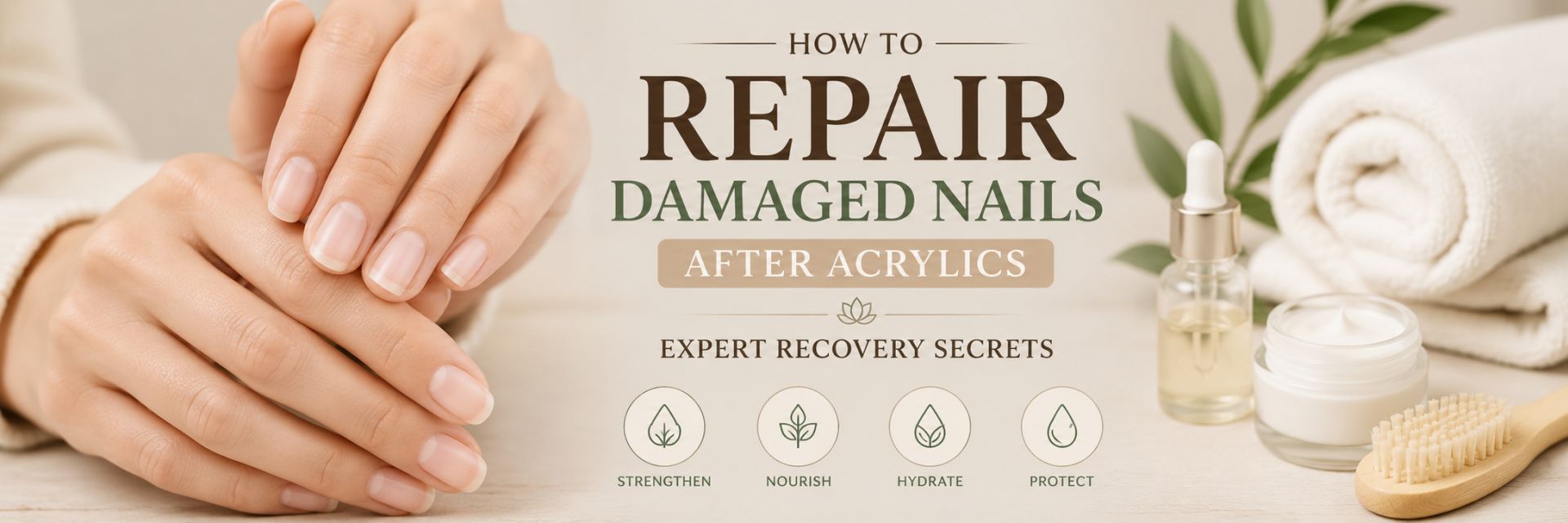
How to Repair Damaged Nails After Acrylics: Expert Recovery Secrets
Taking off your acrylics and getting a good look at what's underneath can feel like a bit of a gut punch. What was once strong, glossy nail plate is now thin, soft, white-streaked, and peeling. It's one of the most common experiences in the beauty world — and one of the most misunderstood. The good news is that nail damage after acrylics is almost always temporary and completely reversible with the right approach. The bad news is that most of the advice circulating online will actually slow your recovery down, not speed it up.
This guide cuts through the noise. Drawing on the same principles used by professional nail technicians and dermatologists, we'll walk you through why acrylic nails cause damage in the first place, how to accurately assess the condition of your nails post-removal, and — most importantly — the exact, step-by-step recovery protocol that genuinely works. Whether you've just had your acrylics removed or you're planning ahead, this is the expert guide you've been looking for.
Nail health is one half of a broader beauty wellness picture. If you're investing in recovery across your beauty routine — from your scalp to your fingertips — our guide to the top nail treatments of 2026 is worth reading alongside this one to understand what professional options are available to support your nails through the recovery process.
Quick Summary: Nail damage after acrylics is caused primarily by mechanical thinning during filing, dehydration from acetone removal, and disruption of the nail's natural moisture barrier. Full recovery typically takes 3–6 months. The fastest path: stop all enhancement products immediately, apply a keratin-based nail strengthener, hydrate the nail and cuticle daily with a quality nail oil, protect nails from water and chemical exposure, and resist the urge to file or buff. Patience — not product quantity — is the deciding factor.
Advertisement · Scroll to continue
Why Do Acrylics Damage Your Nails?
Understanding the mechanism of damage is the first step to addressing it properly. Acrylic nails cause nail damage through two primary pathways, and the severity of your post-acrylic condition depends on how long you wore them, how they were applied, and — critically — how they were removed.
The first pathway is mechanical damage. Before acrylics are applied, the nail technician files the surface of the natural nail to create adhesion. This process — called "nail preparation" or "roughing up the nail plate" — deliberately removes layers of the nail's outermost surface. The nail plate is composed of approximately 50 layers of dead keratin cells; a thorough filing session can remove 10–20% of that thickness in a single appointment. Over repeated sets, cumulative thinning becomes significant. This is why nails feel thin, flexible, and fragile after long-term acrylic use — they are literally thinner than they were before.
The second pathway is chemical and dehydration damage. Acetone — the solvent used to dissolve acrylic polymer — is highly effective at removing the acrylic product, but it also strips the nail plate and surrounding skin of their natural oils and moisture. A standard acetone soak-off removes the nail's lipid content and disrupts the moisture-keratin balance that gives healthy nails their flexibility and strength. This is why post-removal nails often feel brittle, dry, and are prone to splitting — they've been dehydrated at a structural level, not just at the surface.
Recognise Your Level of Damage
Before reaching for products, it's worth pausing to accurately assess what you're actually dealing with. Nail damage after acrylics presents across a spectrum, and the appropriate recovery approach varies depending on severity.
⚠️ See a professional if: you notice significant lifting of the nail plate from the nail bed (onycholysis), greenish discolouration (pseudomonas bacterial infection), or pain and swelling in the nail fold. These require medical attention and will not resolve with at-home care alone.
The Expert Recovery Timeline
Recovery from acrylic nail damage is fundamentally a waiting game — the nail plate must physically grow out from the base, bringing healthy, undamaged nail with it. Understanding the timeline helps set realistic expectations and prevents the frustration that leads many people back to acrylics before their nails have had time to recover.
Triage phase. Stop all enhancement products. Apply nail strengthener, begin daily nail oil routine. Protect nails from water and chemicals. Resist buffing.
Peeling and flaking should begin to reduce. Nail strengthener programme in full swing. New healthy growth visible at the base. Continue protective coatings.
Approximately half the nail plate has been replaced by new growth. Nails noticeably firmer. White spots and delamination moving toward the free edge where they can be trimmed.
Advertisement · Scroll to continue
Complete nail plate replacement. For most people, nails are back to pre-acrylic condition — or better, given the improved home care routine now in place.
The average fingernail grows approximately 3–4 mm per month, meaning a full nail plate replacement from base to free edge takes roughly 4–6 months. This timeline cannot be meaningfully accelerated — but it can absolutely be slowed down by poor nail care choices, particularly re-applying enhancement products before recovery is complete, over-filing, or neglecting daily hydration.
The 7 Expert Recovery Secrets
These are the techniques and principles that professional nail technicians and dermatologists consistently recommend — not the viral hacks or the marketing promises, but the approaches with genuine evidence behind them.
Stop Everything — Including "Protective" Polishes
The single most important step is also the hardest for most people: give your nails a complete break from all enhancement products, including gel polish, shellac, and even "strengthening" top coats with heavy chemical binders. Your nail plate needs to breathe, absorb hydration, and grow undisturbed. The only exception is a simple, breathable keratin nail strengthener in the first few weeks — applied in thin layers only.
Nail Oil is Non-Negotiable — Apply Twice Daily
Cuticle and nail oil is the single most effective at-home recovery tool available. Look for oils containing jojoba, sweet almond, vitamin E (tocopherol), and rosehip — these penetrate the nail plate and surrounding skin effectively, restoring the lipid content stripped by acetone. Apply to the cuticle and nail bed twice daily — morning and before bed — massaging for 30–60 seconds per nail. Consistency over eight weeks produces genuinely visible results.
Use a Keratin Nail Strengthener — Correctly
A good keratin-based nail strengthener (look for hydrolysed keratin or keratin amino acids in the ingredient list) forms a flexible, protective film over the nail plate that reduces breakage while growth occurs. Apply in thin coats every two to three days; do not build up thick layers, as these create rigid coatings that can actually increase brittleness. Remove and reapply with acetone-free remover at the two-week mark to allow fresh application to a clean nail surface.
Protect Nails from Water — Wear Gloves
Prolonged exposure to water — particularly hot water with dishwashing detergent — causes the nail plate to repeatedly expand and contract, accelerating delamination and peeling. This is the most commonly overlooked recovery factor. Wear rubber or nitrile gloves for all washing up, cleaning, and gardening during your recovery period. It feels like an inconvenience; it makes a measurable difference to recovery speed.
Never File Down — Only Shape the Free Edge
Many people instinctively reach for a file when they see uneven or peeling nail surface. Resist. Filing the surface of a damaged nail removes the last layers of already-thinned nail plate and can create heat friction that worsens delamination. Only ever use a fine-grit file (240 grit minimum) on the free edge to maintain a consistent shape that prevents snagging and tearing. Never buff the top surface of a recovering nail.
Nutrition Matters — Focus on These Key Nutrients
Nail growth and strength are directly influenced by nutritional status. Biotin (vitamin B7) at 2.5mg daily has the strongest evidence base for improving nail thickness and reducing brittleness. Collagen peptides, zinc, and iron are also commonly deficient in people experiencing nail fragility. A diet rich in eggs, leafy greens, salmon, and legumes covers most bases. If your nails are taking significantly longer than expected to recover, a blood panel for iron and zinc deficiency is worth considering.
Consider a Professional Nail Treatment Programme
At-home care is effective, but for significantly damaged nails, a professional nail treatment programme provides a level of repair that over-the-counter products simply cannot match. Professional treatments use clinical-grade keratin bonding agents, paraffin wax therapy, and high-concentration vitamin infusion techniques that penetrate the nail plate more deeply than anything available off the shelf. Two to four professional sessions during your recovery period can significantly compress the timeline to visible improvement.
The Best Ingredients for Damaged Nail Recovery
Not all nail products are created equal, and the ingredient list is where the real difference lies. Here's a clear breakdown of what to look for — and what to avoid — when choosing recovery products for damaged nails after acrylics.
| Ingredient | What It Does | Priority |
|---|---|---|
| Hydrolysed Keratin | Bonds to gaps in the nail plate's keratin structure, filling damage and improving flexibility and strength | |
| Jojoba Oil | Closest oil in composition to the nail's natural sebum; penetrates the nail plate and cuticle to restore lipid balance | |
| Tocopherol (Vitamin E) | Antioxidant that supports nail bed skin health and improves moisture retention in the cuticle area | |
| Biotin (topical) | Supports keratin infrastructure; more effective internally as a supplement, but topical forms add a supportive layer | |
| Panthenol (Pro-Vitamin B5) | Humectant that attracts and retains moisture within the nail plate; reduces brittleness and breakage | |
| Calcium | Supports hardness in the nail plate; often included in strengtheners — effective in moderate concentrations | |
| Sweet Almond Oil | Rich in fatty acids and vitamin E; excellent cuticle softener that improves the health of the nail fold | |
| Formaldehyde / Formalin | Found in some "hardening" treatments; creates a rigid nail plate that is actually more prone to cracking on damaged nails | |
| Toluene | Solvent found in some older nail polishes; toxic and drying — avoid entirely during recovery | |
| Acetone (frequent use) | Essential for proper acrylic removal but should be avoided as a regular nail polish remover during recovery — opt for acetone-free formulas |
What to Do and What to Absolutely Avoid
✅ Do This
- Apply nail oil twice daily — morning and night
- Keep nails short during recovery to reduce leverage and breakage risk
- Wear gloves for all wet work and cleaning
- Use a glass nail file (gentler than emery board) on the free edge only
- Apply a thin keratin strengthener every 2–3 days
- Supplement with biotin (2.5mg daily) and collagen peptides
- Moisturise hands after every wash — the cuticle area especially
- Stay hydrated — systemic hydration reflects directly in nail health
- Be patient — grow-out time is irreducible
❌ Don't Do This
- Re-apply acrylics, gel, or shellac before full recovery
- File or buff the top surface of the nail plate
- Pick at or peel lifting nail layers — this worsens delamination
- Use acetone-based remover more than once during recovery
- Soak nails in water for prolonged periods without gloves
- Use formaldehyde-based hardeners on thinned nails
- Ignore signs of infection (pain, swelling, greenish discolouration)
- Expect overnight results — set a realistic 3–6 month timeline
When to See a Professional
At-home recovery works for the vast majority of post-acrylic nail damage. But there are specific scenarios where professional intervention is genuinely necessary and will produce significantly better outcomes than any home care protocol can manage alone.
Advertisement · Scroll to continue
Seek professional nail care or medical advice if:
🔴 You notice greenish or blackish discolouration — this typically indicates a bacterial (pseudomonas) infection that requires medical treatment.
🔴 The nail plate has significantly lifted from the nail bed (onycholysis) — this requires professional assessment to prevent further separation.
🟠 Your nails show no improvement after 8 weeks of consistent at-home care — a professional nail treatment programme with clinical-grade products may be required.
🟠 You have any history of psoriasis, eczema, or thyroid conditions — these can significantly affect nail recovery and should be managed in consultation with a dermatologist.
🟡 You want to speed up your recovery meaningfully — a course of professional nail treatments during the grow-out period can compress the timeline and ensure optimal conditions for new nail growth.
Professional nail treatments during the recovery period are not just cosmetically reassuring — they play a genuine therapeutic role. Trained nail technicians can apply clinical-grade keratin bond rebuilders, carry out careful cuticle maintenance that protects the nail matrix (the growth zone at the base of the nail), and provide personalised guidance on the right products for your specific nail condition. For those in Adelaide looking for expert nail care alongside a broader beauty wellness routine, treatments that address the full picture — nails, skin, and beyond — are worth exploring.
Expert Beauty Treatments in Glenelg, Adelaide
If you're in South Australia and looking for professional beauty care that goes beyond surface-level services, Revive – Head Spa & Beauty at 103B Jetty Road, Glenelg SA 5045 offers a thoughtfully curated range of treatments designed to restore and support your overall beauty wellness — from nail and skin care through to our signature Japanese head spa and scalp treatments. The team brings the same expert, personalised approach to every service. Recovering nails deserve professional attention, and Revive is a great place to start.
View Our Beauty ServicesCan You Prevent This Damage in the Future?
Once your nails have recovered, the natural question is: can you enjoy acrylics again without repeating this cycle? The honest answer is yes — with the right approach. The key variables are the quality of the nail technician applying and removing the acrylics, the frequency of infills versus full sets (which determines how often your nail surface is refiled), and the care you take between sets. Choosing a nail salon that uses a light-touch preparation technique, schedules proper infill timing (every 2–3 weeks rather than letting sets grow out excessively), and performs careful acetone-based removal rather than aggressive filing off is genuinely the difference between minimal and significant nail damage over time.
Between acrylic sets, maintaining a daily nail oil routine and taking biotin consistently will build a healthier baseline for your natural nails — making them more resilient to the process. Our overview of the best nail treatments of 2026 includes options specifically designed for people who enjoy enhancement products but want to actively support their natural nail health alongside them.
It's also worth noting that nail health — like scalp health — is closely connected to overall wellbeing. Stress, nutritional deficiency, hormonal shifts, and dehydration all manifest in the condition of your nails as readily as they do in your hair and skin. Investing in a broader wellness routine — good sleep, hydration, balanced nutrition, and stress management — pays dividends that no product alone can replicate. If you're exploring a more holistic approach to beauty wellness, our guide to relaxation and hair wellness in 2026 offers some genuinely useful context.
Frequently Asked Questions
Q: How long will my nails take to fully recover after acrylics?
A: Full recovery — meaning a completely replaced nail plate grown from the matrix at the base — takes approximately 3–6 months for most people. The exact timeline depends on your natural nail growth rate (typically 3–4mm per month), the severity of the existing damage, and how consistently you follow a recovery protocol. Nails that receive daily nail oil application and protective coating will progress noticeably faster than those that receive no active care, though the grow-out time itself cannot be shortened below a biological minimum.
Advertisement · Scroll to continue
Q: Is it safe to get gel polish while my nails are recovering from acrylics?
A: Generally, no — at least not in the first 4–6 weeks of recovery. Gel polish requires UV curing and acetone removal, both of which add further chemical stress to already-compromised nails. If you feel you absolutely need some colour during recovery, a breathable, water-permeable nail polish in a 3-free or 5-free formulation (free of formaldehyde, toluene, and DBP) is a far gentler option. Remove it with an acetone-free remover and allow your nails a few days of bare recovery time between applications.
Q: Does biotin actually work for nail repair?
A: Biotin has the most robust evidence base of any supplement for nail health. Several clinical studies have shown that biotin supplementation at 2.5mg daily significantly increases nail plate thickness and reduces splitting and brittleness over a period of 6–15 weeks. It is particularly effective for people whose nails are genuinely biotin-deficient — which is more common than many people realise, particularly in those with digestive conditions that affect nutrient absorption. Allow at least 8–12 weeks of consistent supplementation before assessing results, as nail growth is slow.
Q: My nails have green spots under them after removing acrylics — what is this?
A: Green discolouration under a nail after acrylic removal is almost always caused by pseudomonas aeruginosa — a common bacterial infection that thrives in the moist, dark environment created between an acrylic nail and the natural nail plate when lifting occurs. It is sometimes incorrectly called "greenies" or mistaken for mould. This is a bacterial infection and will not resolve with nail oil or strengthener — it requires topical or oral antibiotics. See your GP promptly; left untreated, it can spread and cause more significant nail bed damage.
Q: Can I use a nail drill at home to smooth out rough, peeling nail surfaces?
A: Strongly not recommended. Nail drills — even at low speeds — generate significant heat friction that can cause irreversible thinning and damage to already-compromised nail plate. Professional nail technicians use drills with considerable training and typically avoid them entirely on natural nails during recovery phases. At home, a fine-grit glass file used gently on the free edge is the only appropriate tool. If the surface texture of your recovering nails bothers you cosmetically, a thin coat of nail strengthener applied carefully will provide a smoother appearance without the risk.
Final Thoughts
Repairing damaged nails after acrylics is genuinely achievable — but it requires a combination of the right knowledge, the right products, and a healthy dose of patience. The nails that bounce back strongest are invariably the ones that were given time, consistent hydration, and protection from further chemical and mechanical stress. Cut them short, oil them daily, protect them from water, and give them the 3–6 months they need to fully regenerate.
If your damage is significant, or if your at-home efforts aren't producing the results you'd hoped for after 8 weeks, investing in a course of professional nail treatments is a smart and genuinely effective next step. Your nails — like your scalp, your skin, and every other part of your body — respond remarkably well to expert, consistent care. And the version of your nails that emerges on the other side of a proper recovery is often stronger and healthier than what you started with before your first set of acrylics.