Head Spa & Sleep Series · Article 7
Essential Oils
for Head Spa
The right oil transforms a scalp massage from pleasant to profoundly relaxing. This guide covers the six best essential oils for head spa, how to dilute them safely, and how aromatherapy amplifies your sleep results.
Essential oils are not merely a pleasant accent to head spa — used correctly, they are an active therapeutic layer that works alongside massage to calm the nervous system, lower cortisol, and prime the body for sleep. The key word is "correctly": the right oil, properly diluted, applied at the right moment in the right way.
This guide is built for practical use. You'll find the six oils with the strongest evidence base for relaxation and sleep, precise dilution ratios, three ready-to-blend recipes, and a step-by-step application method that integrates seamlessly with your scalp massage technique.
Why Essential Oils Enhance Head Spa
Touch and scent are processed through separate but complementary neurological pathways — and when both are activated simultaneously, their calming effects are additive, not merely parallel.
Advertisement · Scroll to continue
Scalp massage, as covered in our How Scalp Massage Helps You Fall Asleep Faster, activates the parasympathetic nervous system through mechanoreceptors in the scalp and neck. Aromatherapy works through a distinct route: volatile aromatic compounds bind to olfactory receptors in the nasal epithelium, which project directly into the limbic system — the brain's emotional and memory centre — including the amygdala and hippocampus. From there, signals travel to the hypothalamus, influencing autonomic nervous system tone, cortisol secretion, and sleep-wake regulation.
The result is a dual-pathway intervention: the massage quietens your body from the skin inward, while the essential oil quietens your brain from the nose down. Together, they create conditions for sleep onset that neither could produce as effectively alone.
"Inhalation of lavender essential oil has been shown in multiple trials to reduce anxiety scores, lower salivary cortisol, and improve self-reported sleep quality — effects that are complementary to, and amplified by, the physiological changes produced by concurrent scalp massage."
— Summary of convergent aromatherapy and massage literatureThe 6 Best Essential Oils for Head Spa & Sleep
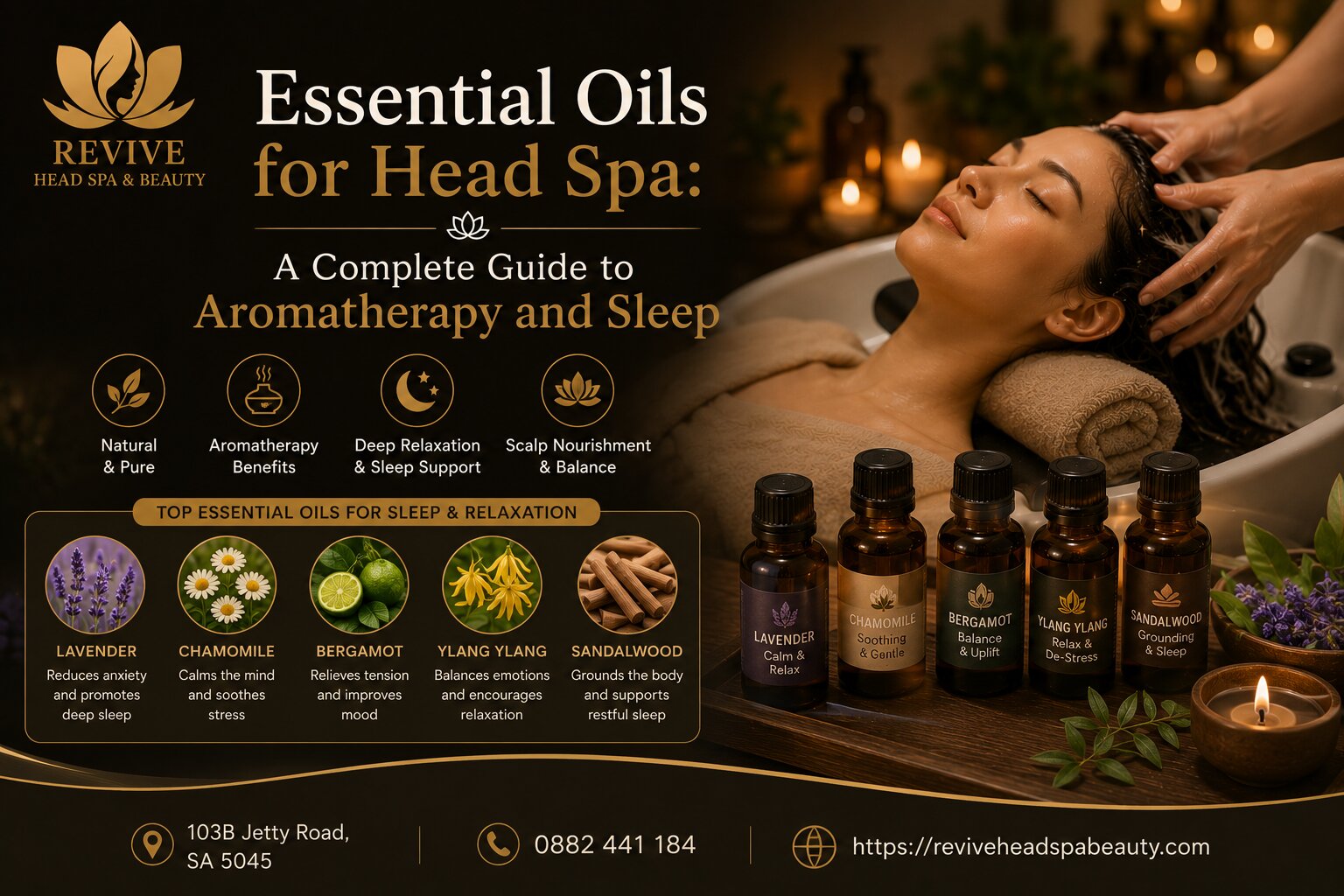
Not every essential oil is appropriate for a pre-sleep head spa. Some — like rosemary and eucalyptus — are stimulating and better suited for morning use. The six below are selected specifically for their parasympathetic and sleep-supporting properties, combined with a suitability for topical scalp application when properly diluted.
Lavender
Lavandula angustifolia
The most comprehensively studied essential oil for sleep and anxiety. Linalool — lavender's primary active compound — has demonstrated anxiolytic, sedative, and cortisol-lowering effects across multiple human trials. It is also one of the safest oils for scalp use and is widely tolerated even by sensitive skin when properly diluted.
Head Spa Use 2–3% dilution in jojoba or sweet almond oil. Warm between palms before application. The go-to choice for a pre-sleep routine — use as the base of any calming blend.
Roman Chamomile
Advertisement · Scroll to continue
Chamaemelum nobile
Roman chamomile (distinct from the more common German variety) contains isobutyl angelate and isoamyl angelate — esters with documented sedative properties. Its sweet, apple-like scent is highly effective at reducing mental chatter and nervous tension, making it especially useful for people whose inability to sleep is driven by an overactive mind.
Head Spa Use 1–2% dilution — Roman chamomile is potent; less is more. Blends exceptionally well with lavender. Avoid German chamomile (blue) on the scalp due to the intense blue colour of azulene.
Cedarwood Atlas
Cedrus atlantica
Cedarwood Atlas contains cedrol — a sesquiterpene with a well-documented sedative effect in inhalation studies. One controlled trial found inhaled cedrol significantly increased non-REM sleep in animal models, and human sleep studies support its calming profile. Its warm, woody scent also makes it an excellent grounding complement to floral oils like lavender and chamomile.
Head Spa Use 2–3% dilution. An excellent addition to scalp blends — cedarwood also supports scalp health by balancing sebum production. Pairs beautifully with lavender and bergamot.
Bergamot (FCF)
Citrus bergamia
Bergamot is unusual among citrus oils in being calming rather than stimulating, owing to its high linalyl acetate content. Studies have shown bergamot inhalation reduces heart rate, blood pressure, and salivary cortisol — directly supporting the parasympathetic cascade triggered by scalp massage. The "FCF" (furanocoumarin-free) designation is essential for scalp use, as standard bergamot contains bergapten, which causes photosensitivity.
Head Spa Use Always use Bergamot FCF (furanocoumarin-free) for scalp application. 2% dilution. Particularly effective for people who experience anxious or low mood alongside sleep difficulties.
Peppermint
Advertisement · Scroll to continue
Mentha × piperita
Peppermint's role in a head spa is distinct from the purely calming oils above — menthol creates a cooling, vasodilatory sensation on the scalp that increases local circulation and relieves tension headaches. While peppermint is broadly stimulating, the physical relief from scalp tension and headache pain can be a powerful facilitator of relaxation when tension is the primary barrier to sleep. Use sparingly and never as the dominant oil in a pre-sleep blend.
Head Spa Use Max 0.5–1% dilution on the scalp — menthol can irritate at higher concentrations, especially near the eyes. Best used early in the massage to relieve tension before transitioning to calming oils.
Rose Geranium
Pelargonium graveolens
Rose geranium is the practical, affordable alternative to true rose absolute (which is prohibitively expensive and rarely appropriate for scalp application). Rich in geraniol and citronellol, it has demonstrated anxiolytic effects in clinical trials and is particularly valued for its hormonal balancing properties — making it especially useful for people whose sleep disruptions are linked to stress hormones or hormonal fluctuations. Its rosy, slightly earthy scent blends beautifully with cedarwood and lavender.
Head Spa Use 2% dilution. Excellent for scalp health alongside its calming properties. A small amount in a blend is sufficient — it is a strong scent that can overwhelm at higher concentrations.
Choosing Your Carrier Oil
Essential oils must never be applied directly to the scalp — they are too concentrated and can cause sensitisation, chemical burns, or follicular damage. They must always be diluted in a carrier oil before use. For scalp application, the carrier oil matters as much as the essential oil — it affects absorption, scalp feel, and whether you'll need to wash your hair afterwards.
| Carrier Oil | Texture | Absorption | Best For | Notes |
|---|---|---|---|---|
| Jojoba | Light, dry | Fast | All scalp types; oily scalps | Technically a wax ester — mimics sebum, won't clog follicles. Top choice for head spa. |
| Sweet Almond | Medium, silky | Moderate | Dry or sensitive scalps | Nourishing, good slip for massage. Avoid if nut allergy is present. |
| Fractionated Coconut | Light, dry | Moderate–fast | General use; sensitive scalps | Odourless and long shelf life. Unlike solid coconut oil, it stays liquid at room temperature. |
| Argan | Medium | Moderate | Dry, damaged, or mature scalps | Rich in vitamin E and oleic acid. Premium option with added scalp-conditioning benefits. |
| Rosehip Seed | Medium, slightly sticky | Slow | Scalp concerns (flakiness, sensitivity) | Richer; best used in small amounts. Short shelf life — store in fridge. |
Recommendation: Jojoba oil is the optimal choice for most head spa applications. Its molecular similarity to scalp sebum means it absorbs well without leaving a heavy residue, and it's suitable for all scalp types including oily and acne-prone.
Dilution: The Non-Negotiable Rule
Dilution is not optional — it is a fundamental safety requirement. The scalp is more sensitive than many other areas of skin, and essential oil sensitisation (an allergic immune response that worsens with each exposure) is a real risk when oils are used undiluted or at excessive concentrations.
Recommended Dilution Rates for Scalp Use
30 ml carrier oil
30 ml carrier oil
30 ml carrier oil
⚠️ Always perform a patch test before full scalp application: apply a small amount of your diluted blend to the inner forearm, wait 24 hours, and check for any redness, itching, or irritation before proceeding. Never exceed 3% concentration for scalp use. Peppermint should be kept at or below 1% near the scalp.
Advertisement · Scroll to continue
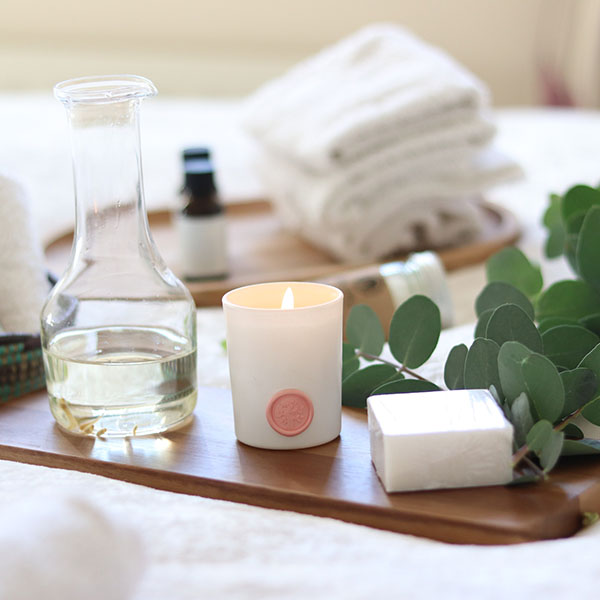
For a practical pre-sleep head spa blend, prepare a 10–15 ml batch (enough for 2–3 sessions) in a dark glass dropper bottle. Add your essential oils first, then top up with your chosen carrier oil. Shake gently before each use.
Ready-to-Use Blend Recipes
These three blends are formulated specifically for pre-sleep head spa use, at safe dilution rates for scalp application. All recipes are based on a 15 ml carrier oil volume. Adjust proportionally for larger batches.
Deep Sleep Blend
Best for: insomnia & cortisol reduction
- Lavender (L. angustifolia) 4 drops
- Cedarwood Atlas 2 drops
- Roman Chamomile 1 drop
Carrier: 15 ml jojoba oil (approx. 2% dilution total)
Tension Release Blend
Best for: stress headaches & neck tension
- Lavender 3 drops
- Peppermint 1 drop
- Bergamot FCF 2 drops
Carrier: 15 ml sweet almond oil (approx. 2% dilution total)
Calm & Balance Blend
Best for: anxious sleep & hormonal balance
- Lavender 3 drops
- Rose Geranium 2 drops
- Cedarwood Atlas 1 drop
Carrier: 15 ml fractionated coconut oil (approx. 2% dilution total)
Store all blends in dark glass bottles (amber or cobalt), away from direct light and heat. Shelf life is approximately 6–12 months depending on the carrier oil used. Label each bottle with the date of preparation.
How to Apply Oils During Head Spa
Application technique determines how well the oils are absorbed and how effectively the scent is delivered to the olfactory system. The following sequence integrates oil application seamlessly into a scalp massage:
Warm the oil before contact
Dispense 3–5 drops of your blended oil into your palm and rub both hands together for 10–15 seconds. This warms the oil, enhances dermal absorption, and releases aromatic compounds into the air. Cup your hands over your nose and take 2–3 slow, deliberate inhalations before touching your scalp — this begins the olfactory limbic pathway activation immediately.
Apply to the scalp in sections
Using your fingertips (not your nails), dot the oil across the scalp in small amounts — parting the hair and applying directly to the skin rather than to the hair shaft. Work from front to back: hairline, temples, crown, and nape. You want skin contact, not saturated hair.
Begin effleurage to spread and absorb
Use long, slow effleurage strokes to evenly distribute the oil across the scalp. This initial phase serves double duty: it spreads the oil and begins the parasympathetic activation described in Article 1. Maintain a slow pace — under 3 cm per second — to maximise C-tactile afferent activation.
Progress to circular kneading
Once the oil is distributed, continue into deeper circular kneading across the scalp. The carrier oil provides the slip needed for this technique to feel comfortable rather than pulling on the hair. Focus on areas of tension: the hairline across the forehead, just behind the ears, and the nape of the neck.
Finish with a warm towel wrap (optional but recommended)
Wrap a warm (not hot) damp towel around your head for 5–10 minutes. The gentle heat opens the hair follicle and enhances absorption of both the carrier and essential oil compounds into the scalp. It also creates an immersive sensory experience that deepens the parasympathetic relaxation state — the warmth and slight compression are independently calming.
Leave on or rinse — your choice
For maximum scalp benefit, leave the oil on overnight and shampoo in the morning. If you prefer to sleep without an oil-on-pillow feeling, wait at least 20 minutes post-massage before rinsing with a gentle shampoo. Avoid vigorously scrubbing — you want to preserve some of the calming benefit of the massage.
Safety Guidelines
Essential oils are potent botanical compounds and warrant the same level of care as any active ingredient. The following guidelines ensure you get the benefits without the risks:
Essential Oil Dos
- Always dilute before scalp application — never apply neat (undiluted)
- Patch test every new blend 24 hours before full use
- Use Bergamot FCF specifically to avoid photosensitivity reactions
- Store in dark glass bottles, away from heat and direct light
- Keep peppermint well away from eyes, nose, and any broken skin
- Source from reputable suppliers — look for GC/MS test certificates
- Check individual oil contraindications if pregnant or breastfeeding
Essential Oil Don'ts
- Don't exceed 3% total dilution on the scalp
- Don't use stimulating oils (rosemary, eucalyptus, basil) in a pre-sleep blend
- Don't apply to an inflamed, broken, or infected scalp
- Don't ignore a reaction — wash off immediately if itching or burning occurs
- Don't ingest essential oils — topical and aromatic use only
- Don't use standard Bergamot (containing bergapten) on the scalp
- Don't assume "natural" means risk-free — all active compounds carry risks at incorrect doses
Specific contraindications to discuss with a healthcare provider before using essential oils: epilepsy (several oils are convulsant at high doses), hormone-sensitive conditions (some oils have oestrogenic effects), pregnancy (particularly the first trimester), and use of anticoagulant medications.
References & Further Reading
- Lillehei AS & Halcon LL. (2014). A Systematic Review of the Effect of Inhaled Essential Oils on Sleep. Journal of Alternative and Complementary Medicine. liebertpub.com
- Takeda A, et al. (2017). Controlled Study of the Effects of Aromatherapy on Insomnia in Older Adults. ScienceDirect
- Seol GH, et al. (2010). Antidepressant-like Effect of Salvia sclarea Is Explained by Modulation of Dopamine Activities in Rats. Journal of Ethnopharmacology.
- Komiya M, et al. (2006). Lemon Oil Vapor Causes an Anti-Stress Effect via Modulating the 5-HT and DA Activities in Mice. Behavioural Brain Research.
- Tisserand R & Young R. (2014). Essential Oil Safety: A Guide for Health Care Professionals (2nd ed.). Churchill Livingstone/Elsevier.
- Kim IH, et al. (2016). The Effect of a Scalp Massage on Stress Hormone, Blood Pressure, and Heart Rate of Healthy Female Office Workers. ResearchGate